 Solutions for all joint sizes
 No wet Weather delays
 Non staining, Easy clean
Porcelain Paving Performance and Characteristics
Whilst porcelain tile paving can have tremendous potential and advantages, with this rapidly increasing trend towards using porcelain in the last few years, we have also seen that some of the positive characteristics have sometimes been exaggerated or taken a little too literally shall we say! Therefore it is probably good at this point in our dissertation to note and review some of the key performance characteristics – and todate we have heard all the following ‘characteristics’ individually or more usually combined, as the ‘reason’ people have originally decided to use porcelain tile paving:
“We are using porcelain tiles for our paving project because they are non-slip and do not need cleaning as they are washed clean in the rain and….
- …… Red wine spills will not stain it!
- …… BBQ fats, oils, grease, and foodstuffs will not mark it!
- …… Bird droppings can be brushed-off!
- …… Algae, moss, and other green growths, leaf and grass stains will just wipe-off!
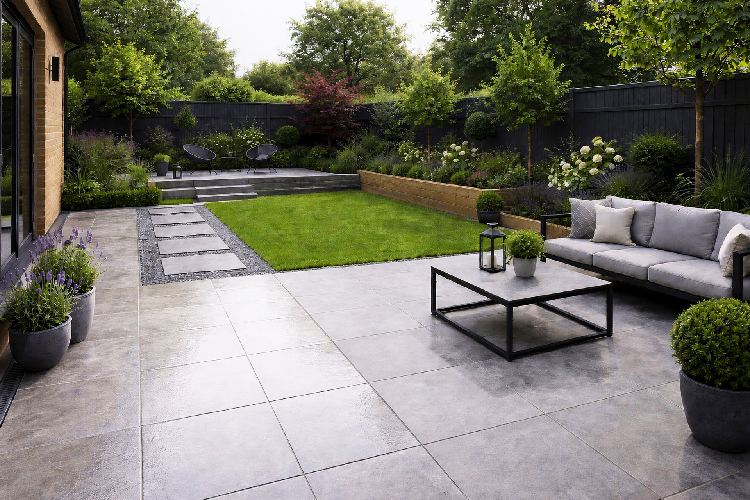
So, porcelain paving needs any special cleaning or additional sealing / care and protection………!”
Really…. Good luck with all of this …!?! Porcelain to paving is therefore the universal panacea and answer to the maiden’s prayer then……?
No seriously though, much of this is, or at least can be, more-or-less true - BUT not always, and it is always a question of degree and must be considered with common sense and sensible limitations!
Let’s have a look at each of these Performance Characteristics and hopefully explain:
Firstly, the facts-of-life are that like any outdoor surfaces, external porcelain tile paving will always need a good cleaning and maintenance regime and depending on the specific porcelain surface profile / texture and its exposure, the surfaces may also benefit from additional surface protection and sealing on site. We always advise caution in making external porcelain tile paving performance in service assumptions, because as always and again as with all types of paving, there are other important factors to be considered. So, we find that this is really a question of the level and relative ease of staining and/or ease of cleaning specific porcelain surfaces in different specific situations and exposure in different specific environments. For sure, all dense, highly fired, porcelain ceramic surfaces are going to resist staining and be far easier to clean than porous sandstone paving for example, but this may only be comparable with properly sealed sandstone or granite paving. This is always going to be a question of the type, extent, and scale of spillages, and like all exposed external horizontal surfaces, all types of porcelain tile will require regular if not frequent cleaning, and they may require some form of additional protection at sometimes, according to the exposure. For example, appropriate additional protection / sealing can make porcelain surfaces much more resistant to staining and easier to clean after spillages – horses for courses!


Cleaning and Sealing Porcelain Paving
Unfortunately, some people only find this out when their new porcelain tile paving, including their porcelain paving grout, is stained, and their porcelain surfaces seem to need frequent cleaning to keep their attractive appearance. This can be a difficult time for everyone involved, including the patio owner, paving contractor, tile merchant, tile manufacturer and lastly but not least!) the paving grout manufacturer – Everyone can get dragged into time-consuming debate and argument that is always best avoided. This is best done from the beginning of the process - In practical terms, porcelain tile paving is much like any other external paving and hard landscaping surfaces, as these all need to be installed correctly and then kept clean with an appropriate regime established, to keep the surfaces in prime condition for the best long-term performance and aesthetics. Fortunately, NCC have extensive experience, expertise and have invested in the research and development of the best materials to help you do this most easily, successfully and cost effectively, right from the beginning, with all types of paving and especially porcelain tile paving.
On the more detailed Paving Cleaning and Paving Sealing pages of this website there is a lot more information on products developed specifically to clean and protect all types of paving, as well as some special products that are designed specifically for external porcelain tile paved surfaces. All these products are also available from this website in our Online Shop Products specifically designed for external porcelain tile paving include:
- NCC Porcelain Cleaner - Aftercare - Porcelain Cleaner - Aftercare is designed to make porcelain tile surfaces faster and easier to cleaning and to be used frequently for regular Aftercare.
- NCC Porcelain Intensive Cleaner – As it says on the tin – for the Porcelain Intensive Cleaner is designed for the intensive cleaning of porcelain tiles surfaces after heavy soiling, and/or at the end and the beginning of the annual ‘alfresco’ season for example - Whenever that is in the UK!
- NCC Porcelain Protector – As it says on the tin – Porcelain Protector is a specially developed external porcelain tile surface sealer, which can be applied prior to the initial tile grouting (see below) operations, or after thorough cleaning at any time, where this protects the surfaces by increasing resistance to future staining and making cleaning easier.
- Porcelain Protect & Enhance – A 'wet-look' porcelain surface sealer & protector that enhances the colours and embellishes the appearance. Tough and highly resistant to staining, it facilitates reduced dirt pick-up, for lower maintenance and easier cleaning.
Note: We should probably also say here, amidst what are not meant to be demeaning comments about porcelain paving, as we do believe that handled correctly, external grade porcelain tile paving is a fantastic addition to the landscaper’s options, and it is ideal for many domestic patios, terraces, and pathways.
Porcelain Paving Slip Resistance
Well yes it can be, especially when tested to the International, and mostly European (read German) Test Standards and test procedures that are now generally used as the basis for such statements. These standards are also widely used for many other types of floor coverings, from vinyl sheeting to resin flooring and even carpets and ceramics, including porcelain tiles – BUT as clearly stated, most of these test procedures were and are intended as INTERNAL FLOOR tests i.e. for floor covering materials used indoors and for ‘shod’ feet (wearing shoes), whilst barefoot testing, such as for use around swimming pools is something else again, take a look at the tile profiles near your local public pools – hmmmmm?
There doesn’t seem to be any standardised test for this form of surface when used outdoors. However, notwithstanding this, the results of these tests and the classifications received by specific porcelain tiles, can be a very good guide to their potential slip and skid resistance. BUT their actual slip resistance performance will almost equally depend on the interaction of other important aspects including any slope, the type and extent of spillages, the nature of any footwear and the type of activities in the area e.g. running is always more risky!
Slip resistance measurement and standards

The commonly referred to R ratings relate to the typically non portable DIN Standard Floor RAMP Test for Shod Feet, where the ‘R’ relates to the ‘R’ in Ramp Test This basically works by floor samples being fixed to a ramp and then oil is applied on to it, whilst the ramp is raised and then the trained test technician walks in small steps backwards and forwards wearing boots until they slip on the floor. The computerised readout then determines the R ratings for the floor surface based on the angle of slip. Note - the values start at R9 which is the LOWEST slip resistance and R Rating (NOT R1 as you would think – no one seems to know why…?); the R Ratings then progress through increasing values of resistance to the HIGHEST floor slip resistance at R13, the highest slip resistance achievable in the test.

’ABC’ Ratings for BARE FEET must conform to DIN 51097. ABC Ratings are used for wet floor conditions where bare feet are the norm such as saunas, Jacuzzis, public showers, swimming pools etc.
German standards DIN 51130 and stipulate an ‘R rating’. These tests involve a person walking up and down a ramp where the surface is the test floor contaminated with oil whilst the angle of inclination is increased. The results are given in a range (starting for no good reason we know) at Class R9 - Most likely to be slippery, and they go up to Class R13 – the least likely to be slippery - BUT - When the surface is wet and/or contaminated with spillages, and outdoors – Don’t bank on it!
So in summary – Yes - Porcelain Tile Paving can be slip resistant, but please use common sense – All and any external paved surfaces, using porcelain, natural stone, or concrete, can and will be slippery and therefore dangerous in some situations, and especially when wet and/or contaminated with any other spillages – especially any oils and greases, where dense porcelain maybe more slippery as none is absorbed into the surface, therefore increasing the risk of slips and falls! Common sense is required!
Porcelain Paving Cleaning and Jet-washing
Porcelain paving does not need cleaning e.g. by jet-washing……? Well maybe, BUT ONLY if you keep it pristine clean and treat the porcelain paved surfaces like you do your indoor floors, where you would normally remove and completely clear-up any spillages immediately. Plus, again as you would do indoors, you ensure that the porcelain paved surfaces are swept and mopped clean at least once a week or so, according to use, and that this cleaning regime continues throughout the year, EVERY WEEK of the year and NOT JUST IN SUMMER! – Otherwise, you will find it necessary to jet wash your new porcelain tile paved surfaces regularly, if not frequently, but it will be advisable to do so several times every year as a minimum, to keep it clean and looking good! This will certainly be necessary at the start & end of the season, as well as after any days of heavy use and/or spillages!
As YOU WILL need to jet wash your porcelain tile paved surfaces, please be sure to point the tiles with a paving grout / paving jointing mortar that can withstand this direct jet-washing treatment and will not wash-out! As mentioned, and explained in more detail elsewhere on this website, NONE OF THE 1-part, air-drying, vacuum packed ‘resins’, bag-in-a-tub products, so-called ‘resins, or ‘brush-ins’, paving joint compounds etc., are suitable for porcelain tile paving in the long term. Not even GftK’s own Patio grout or vsw 840+, as none of this type of product can fully / adequately resist direct jet-washing - There are many brands widely available in most merchants; they may seem relatively cheap and very easy to apply - BUT - They will cause you problems with your nice new porcelain paving – and usually sooner rather than later, so all these compounds are best avoided - Even gftK’s Patio grout, which is tested and proven to be the best 1-prt, air-drying, paving joint mortar. BUT it will not take direct jet-washing for very long. Why on earth would you want to select expensive porcelain tile paving, and then use the cheapest ‘brush-in resin’ or tile grout available from in the local Garden Centre, Stone or Builders Merchant – Or from anywhere come to that……!
You can also email us for more specific support: sales@nccstreetscape.co.uk and you can call our Customer service team during normal office hours, on 01257 266696 for FREE Expert Advice.
Case Studies
Porcelain Patios
This homeowner in Bury, was very proud of his beautiful, new and extended porcelain patios but, unfortunately they...
View Case Study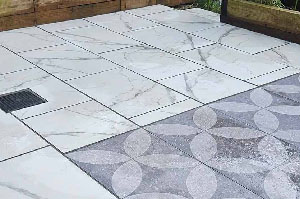
Porcelain Patio Refurbishment
The owners of this property, in the picturesque village of Croston, in Lancashire, were desperate to find...
View Case Study
Porcelain Patio & Pathways
The stylish and linear design of this garden in an exposed location, a few miles inland of Garvin on the...
View Case Study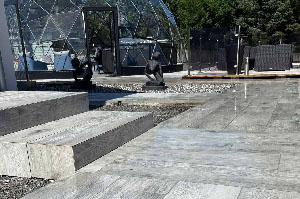
What makes NCC Streetscape Different?


We provide the best paving jointing solutions for all types of paving in all types of areas, and joint sizes. This includes optimum solutions for jointing and repointing works in all domestic, commercial, and public paved areas.
We are the Exclusive UK & ROI Agents & Suppliers of GftK GmbH., the global technology leaders in paving jointing, with unique products that allow quick and easy application, even in wet weather, then provide high performance and extended durability for a long service life.
We provide FREE Expert Technical Advice to select the right product on every project, with additional guidance to prepare and successfully complete the job, including our renowned training and site support service.
We have a reputation for quality, reliability, and service, from professional paving and landscaping contractors, specifiers and authorities, as well as our and DIY customers.